
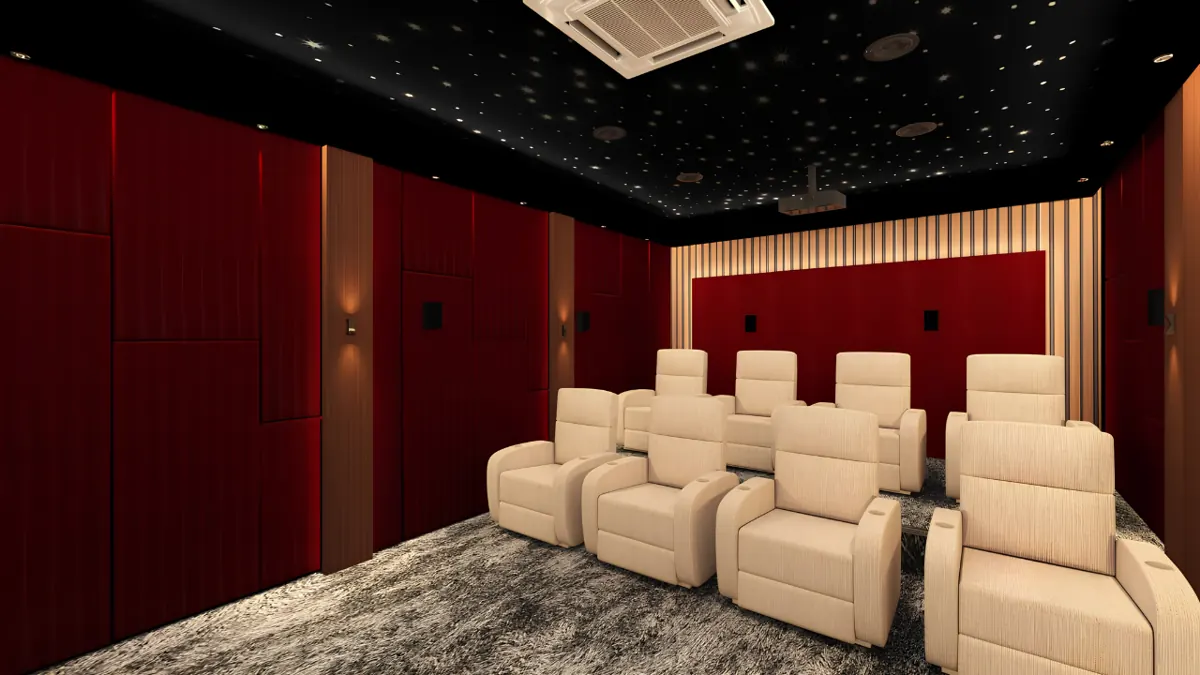
A Dolby Atmos home theatre adds sound from above, so rain, helicopters and effects move around you instead of just left and right. Planning the speaker layout early is essential, because ceiling speakers and cables are far easier to install before the false ceiling is closed.
What the numbers mean
Layouts are written as three numbers. In 5.1.2, there are five ear-level speakers, one subwoofer and two height or ceiling speakers. In 7.1.4, there are seven ear-level speakers, one subwoofer and four height speakers. More speakers create a more precise sound field, but the room and budget should decide how far to go.
5.1.2: the practical starting point
A 5.1.2 setup suits smaller rooms and living-room theatres. It has left, centre and right speakers at the front, two surrounds at the sides and two overhead speakers. It delivers the Atmos effect without needing a large room or an extensive build.
7.1.4: for dedicated rooms
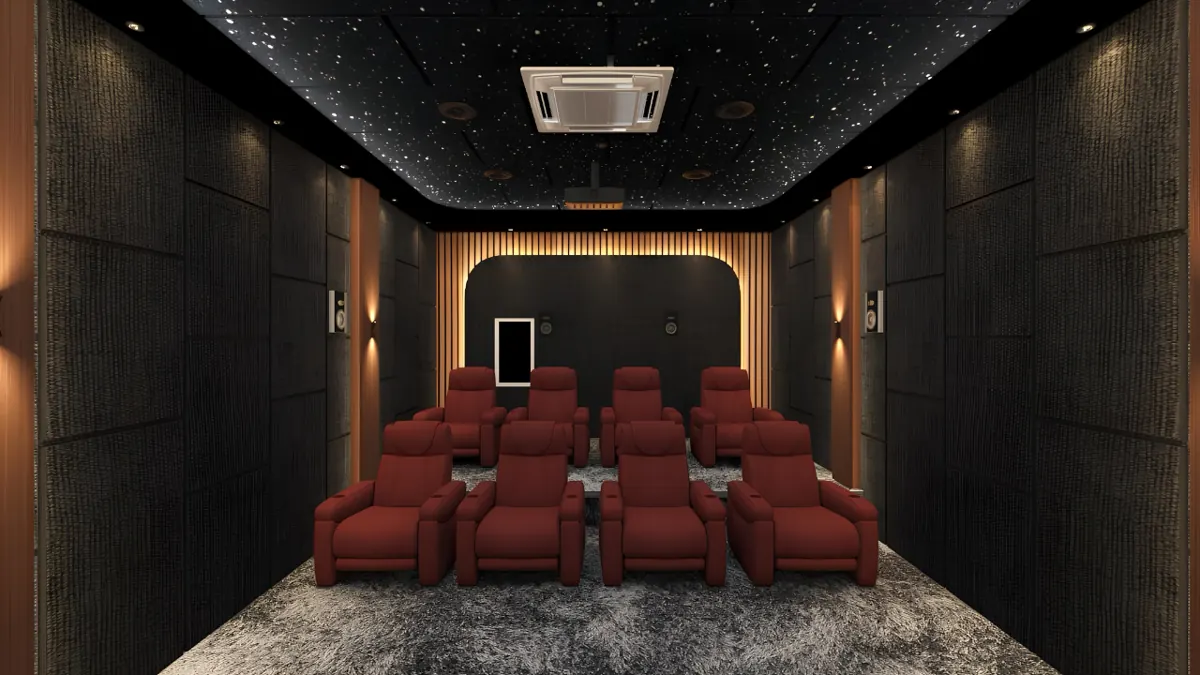
A 7.1.4 layout adds rear surrounds and four overhead speakers. It suits dedicated theatres with two rows of seating, because rear and overhead coverage reach every seat. It needs more wiring, more amplifier channels and a ceiling that can hold the speakers.
Speaker placement basics
- Front left and right: roughly equal to the main listening position's distance, angled slightly inward
- Centre: directly above or below the screen, aimed at the listeners
- Surrounds: at the sides, level with or slightly above ear height
- Overheads: on the ceiling, in line with or slightly ahead of the main seats
- Subwoofer: placed after testing, often near the front wall or a corner
Exact positions depend on the room and the equipment, and are fine-tuned during calibration.
Room and ceiling requirements
Overhead speakers need ceiling height and a surface that holds them securely. A false ceiling can hide in-ceiling speakers and cables. Rooms with very low ceilings can still work with up-firing speakers, though dedicated in-ceiling speakers usually sound better. Plan these during the interior design stage.
Equipment you will need
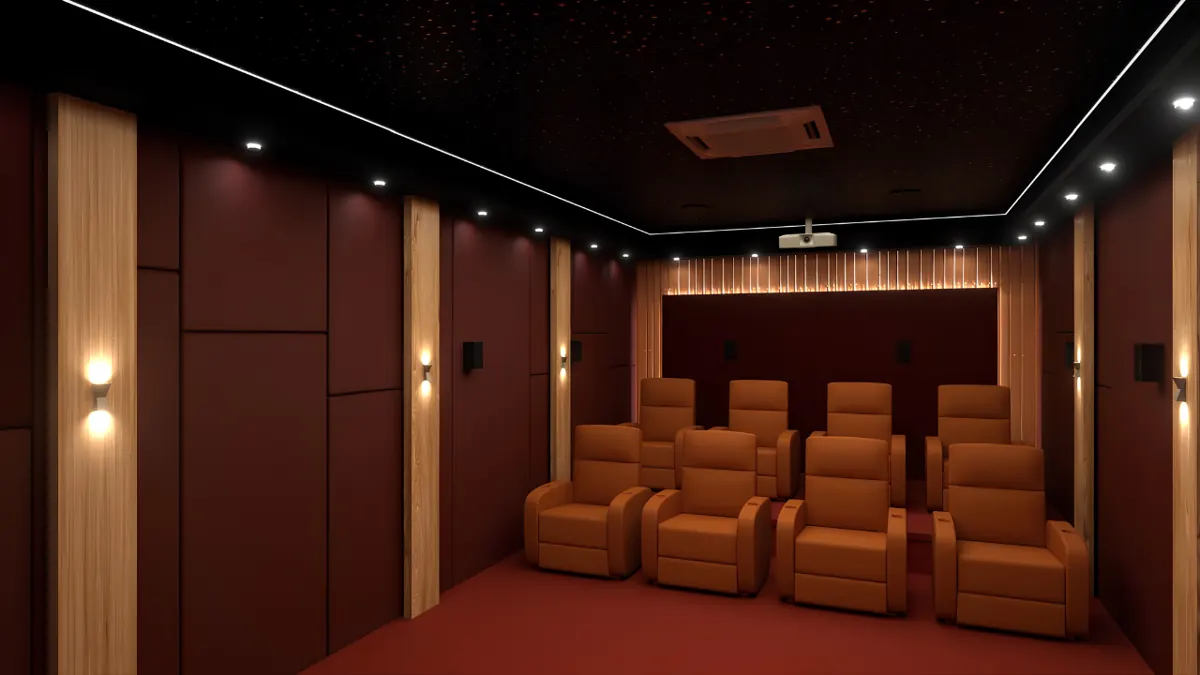
You need an AV receiver or processor that supports Dolby Atmos, a suitable number of amplifier channels, speakers matched in tone and Atmos-capable sources such as streaming devices or players. Content matters too, so check that your streaming services deliver Atmos. Compare displays in projector vs TV.
Acoustics still come first
Even the best Atmos system suffers in a reflective room. Combine your layout with treatment from our acoustics guide. Good seating and room layout matter equally, as shown in room size and seating layout.
Which content actually uses Atmos?
Atmos is available on many streaming platforms, on some discs and in selected games and music. Check that your source devices, streaming plan and cables support it, and that your receiver is set up correctly. Without Atmos content, the extra speakers simply upmix standard content, which can still sound good but is not the same. Make a list of what you actually watch before investing in overhead speakers.
Choosing speakers that blend
Speakers in a surround system should come from the same family so they match in tone. Mixing brands can cause sound to jump unnaturally between speakers. Ceiling speakers should have a similar voicing to the front speakers. A good installer will audition options in your room, or in a demo room, rather than choosing from a spec sheet.
Subwoofers: one or two?
Bass is where rooms differ most. A single quality subwoofer is a good start. In larger rooms or rooms with uneven bass, two subwoofers placed in different positions can smooth the response across seats. Placement matters more than size, so test positions before fixing the final place.
Calibration and room correction
Modern receivers include automatic room correction using a microphone. It measures distances, levels and frequency response and adjusts the sound. It is helpful, but not perfect. Professional calibration refines the result, and the sound improves noticeably. Make calibration a line item in your quotation.
Is Atmos worth it for your room?
Atmos shines in rooms with enough height, treated acoustics and a reasonable budget for quality speakers. In small rooms with low ceilings or poor treatment, money may be better spent first on acoustics, seating and a solid 5.1 system. In larger dedicated rooms, an Atmos upgrade can transform the experience, adding realism to rain, flyovers and music mixes. Decide based on room, budget and how often you watch Atmos content.
If you are unsure, plan the conduits and ceiling for Atmos, install a 5.1 system today and add the overhead speakers later.
Wiring and power planning for Atmos
- Run speaker cables for all positions, including ceiling points, before closing the ceiling
- Plan a ventilated rack with enough power points
- Use proper gauge speaker cable for the distances
- Label every cable at both ends
- Leave service loops in the ceiling for adjustments
Plan the wiring before the ceiling closes
Cable routes for every speaker, power for amplifiers and ventilation for the rack should be set before walls are finished. This is a common reason to involve a specialist early. Contact us to plan a theatre with the right speaker layout for your room.
Frequently asked questions
Do I need Dolby Atmos?
No, but it adds a realistic sense of height and movement. It is most noticeable in a well-treated room.
Can I upgrade from 5.1 to Atmos later?
Yes, if conduits and ceiling access were planned. Otherwise it needs more rework.
Are in-ceiling or up-firing speakers better?
In-ceiling speakers generally give more accurate overhead effects. Up-firing models help when the ceiling can't be modified.
How many speakers do I need?
A 5.1.2 layout suits compact rooms; 7.1.4 suits larger dedicated theatres.
Keep reading
Home Theatre Room Size and Seating Layout Guide
Plan your home theatre room size and seating layout with simple rules for screen distance, row spacing, risers and aisle width, tailored for Bangalore homes.
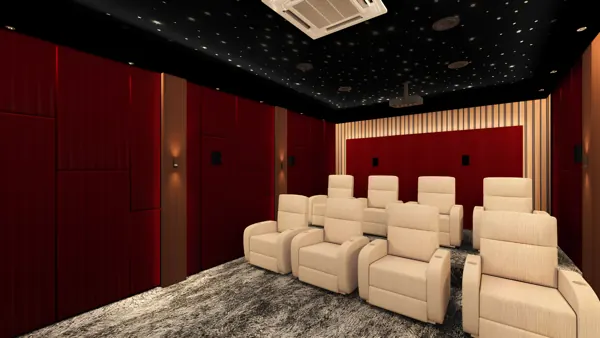
Home Theatre Acoustics and Soundproofing in Bangalore
Understand home theatre acoustics and soundproofing in Bangalore: absorption vs isolation, panels, doors, flooring and how to keep noise from neighbours.
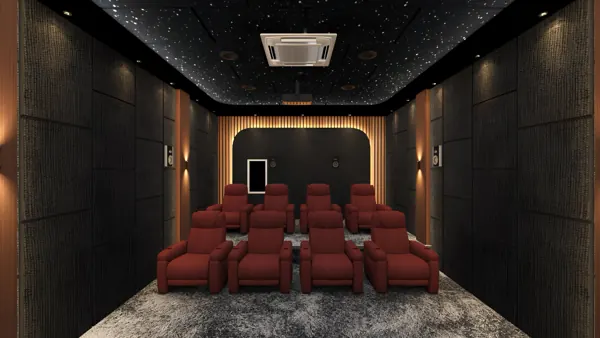
Home Theatre Cost in Bangalore: Price Drivers and Budget
How much does a home theatre cost in Bangalore? Learn what drives the price - room work, acoustics, display, sound, seating - and how to plan a smart budget.