
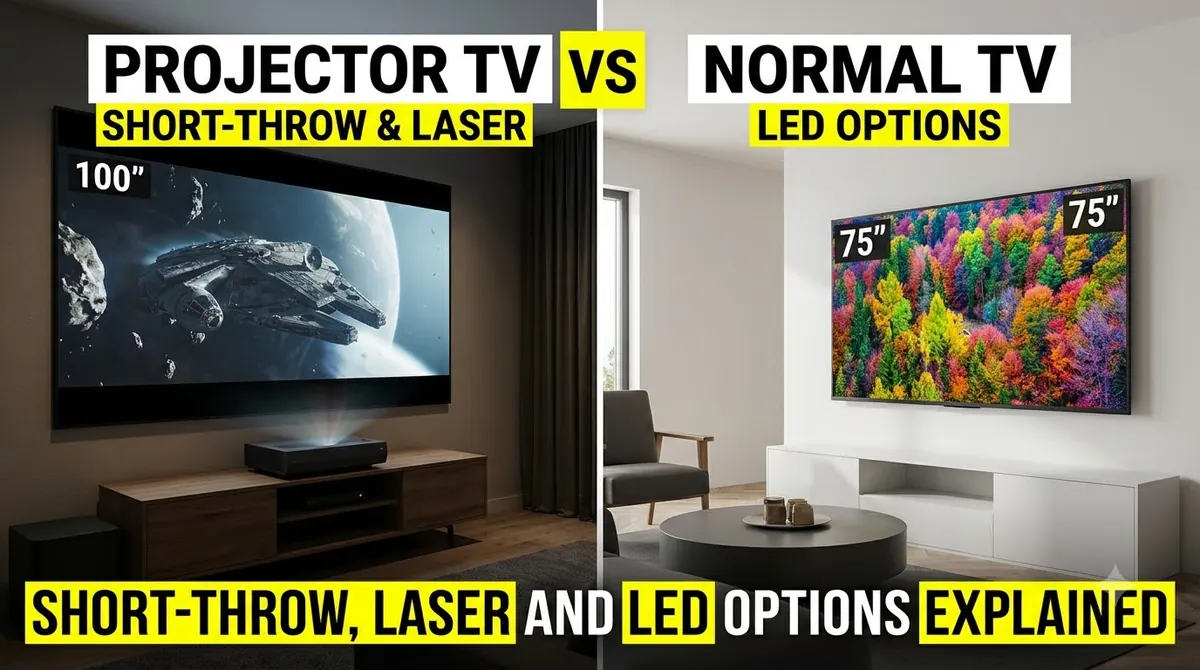
A projector TV looks like a stylish box on a cabinet but throws a huge picture on a wall or screen. A normal TV is a flat panel on the wall. Projector TV vs TV is now a real choice for Bangalore homes, so here is a simple guide to short-throw, laser and LED options and who should buy what.
What is a projector TV
A projector TV, also called a laser TV or ultra short-throw (UST) projector, is a projector designed to sit very close to the wall, often 10 to 40 centimetres away, and project a large picture upward. It includes a tuner, speakers and smart apps, so it works like a TV and does not need a ceiling mount.
Short-throw, ultra short-throw and normal projectors
- Normal projector: needs 2 to 4 metres or more of distance and is usually ceiling mounted.
- Short-throw projector: needs about 1 to 2 metres.
- Ultra short-throw (UST) or laser TV: sits right below the screen. It is the closest match to a TV in daily use.
Laser, LED and lamp light sources
Projectors use lamp, LED or laser light. Laser and LED sources are brighter, start instantly and last far longer than lamps. A laser UST projector is the best choice for living rooms, because it can handle some ambient light. LED projectors are compact and cheaper but less bright. See projector life vs TV life for details.
Normal TV types: LED, QLED and OLED
LED and QLED TVs are bright, affordable and reliable. OLED TVs offer perfect blacks and excellent contrast but cost more and can be less bright. All of them are easy to place and need no special room. For most households, this is the simplest option.
Picture size and cost per inch
A projector TV can deliver 100 to 120 inches or more at a price that compares well with a 75 to 85-inch TV. If you want a truly large picture, a projector TV is the more economical route. If 55 to 75 inches is enough, a normal TV is cheaper and easier. See projector vs TV cost.
Brightness and daytime viewing
Normal TVs win in bright rooms. Projector TVs, especially with an ambient-light-rejecting (ALR) screen, work well in living rooms but still look best with curtains drawn. If you watch mainly in daylight, think carefully before choosing a projector TV.
Space, wall and screen needs
A projector TV needs a flat, clean wall or a screen and a low cabinet at the right distance from it. A normal TV needs just a wall mount or a stand. Measure the wall, the cabinet and the distance from the screen before you decide.
Sound, smart features and gaming
Projector TVs often include decent speakers, but a soundbar or surround system is still better. Gaming performance on projector TVs has improved, though normal TVs still offer lower lag. Both options support streaming apps.
Who should buy a projector TV
- Families who want a big cinema feel in the living room without a ceiling mount.
- Homes where the wall is large and clean.
- Those who mainly watch in the evening.
Who should buy a normal TV
- Homes with bright rooms and lots of daytime viewing.
- Gamers and sports fans who want lowest lag.
- Anyone who wants a simple setup and the lowest cost.
Projector TV vs TV: ALR screens explained
ALR stands for ambient light rejecting. An ALR screen is designed to reflect light from the projector toward you while rejecting light coming from windows and lamps. This lets an ultra short-throw projector TV look good in a living room with some light. Without an ALR screen, a projector TV on a plain wall is more suited to dim rooms.
Projector TV vs TV: setting up in your living room
Set the projector TV on a low cabinet at the distance recommended by the manufacturer from the wall, often a few centimetres to about 40 centimetres. The wall or screen must be flat. Keep the cabinet stable, because even a small movement changes the picture. Plan the power point and cables so that nothing is visible. A TV, by contrast, only needs a wall or a stand.
Projector TV vs TV: quick comparison
- Picture size: projector TV wins.
- Daylight performance: TV wins.
- Ease of setup: TV wins.
- Cost for 100 inches and above: projector TV wins.
- Gaming lag: TV usually wins.
Our advice
If you can control the light and love big screens, try a laser projector TV. If not, a QLED or OLED TV is the safer buy. Compare in person where possible. Read HD projector vs TV for the wider comparison and custom home theatre in Bangalore if you plan a dedicated room. Contact us for help.
Frequently asked questions
What is the difference between a projector TV and a normal TV?
A projector TV projects a large image onto a wall or screen from a short distance, while a normal TV is a flat panel with its own display.
Is a laser TV good for a living room?
Yes, a laser ultra short-throw projector works well in living rooms, especially with an ALR screen and some light control.
Do projector TVs need a special screen?
They work on a plain wall, but a proper screen gives better contrast and brightness.
Which lasts longer, a projector TV or a normal TV?
Laser and LED projectors can last for many thousand hours, and TVs also last long. Real life depends on use.
Is a projector TV cheaper than a big TV?
For 100 inches and above, usually yes per inch.
Can I use a projector TV for gaming?
Yes, for casual gaming. Competitive players may prefer a TV with lower input lag.